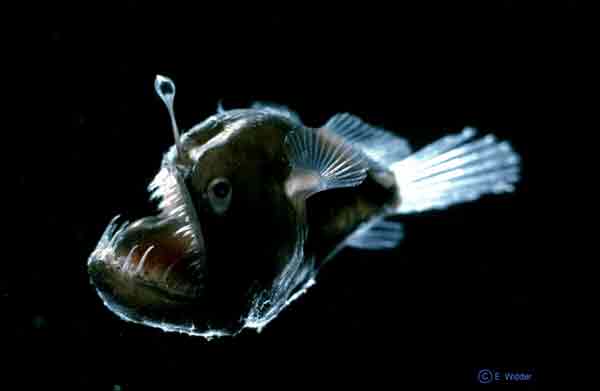
While the concept of deep sea fish may be a bit variable in terms of
the depth they inhabit, it is usually understood that deep sea fishes
are those living in the bathypelagic, abyssopelagic and demersal zone.
Bathypelagic species, such as the angler fishes, inhabit the deeper part
of the pelagic zone, lives from from 1,000 m down to around 4,000 m,
while abyssopelagic species live from 4,000 m down to above the ocean
floor. Demersal species occupy the bottom of the ocean floor and are
divided into benthic and benthopelagic species. Benthic fishes are
those that spend most of their time on the bottom such as the rays and
flatfishes, while benthopelgic fishes are those that swim habitually
near the ocean floor such as the squalid sharks (family Squalidae) and
smoothheads (family Alepocephalidae).
Physical Conditions?
The conditions of the deep sea are extreme and the species inhabiting
the area are challenged with adapting to these conditions. The most
challenging is perhaps the high hydrostatic pressure. For each 10m
increase in depth, the pressure increases by 1atm (~0.101MPa). The
average pressure below 1000m is near 380atm while the maximum may reach
up to 1100atm. In addition to the high pressure, the temperature in
deep sea is very low, typically in the range of 2-4°C. Lack of sunlight
is another condition these animals are challenged with affecting their
vision as well as the photosynthetic production below ~100m. Due to
these extreme conditions, the deep sea species are expected to possess
well adapted biochemical systems. Also, for the same reason, the
bacteria that inhabit the organs of these species are mostly
extremophiles such as barophiles and psychrophiles.
Bioluminescent Bacteria
As mentioned above, bioluminescent bacteria and deep sea fish
maintain a symbiotic relationship to give the fish a source of light.
Bioluminescent bacteria are classified in the genera Vibrio and
Photomicrobium, and look like curved rods usually 1-3 microns long, with
a motile flagella. They survive in seawater, fish digestive tracts, the
outside of decaying fish, and their symbiotic relationship is most
commonly found in angler fish, flashlight fish, and the bobtail squid.
Biochemistry
and Quorum Sensing
How do they make light?
FMNH2 + O2 + RCHO --> FMN + RCOOH + H2O + Light
This reaction involves the oxidation of substrate luciferin in
the presence of an catalytic enzyme luciferase. LuxA and LuxB catalyze
the luciferase reaction, using oxygen and a reduced flavin
mononucleotide to oxidize a long chain aldehyde RCHO. It results in the
production of light and and inactive oxyluciferin, ATP used as energy to
produce more luciferin. Sometimes luciferin and luciferase are bound
together in a single molecule called “photoprotein”, which can be
triggered by calcium ions to produce light. Most of the energy produced
is emitted as light rather than heat, and the creation of light occurs
only when organisms are present in high cell densities.
Quorum sensing is the cell to cell communication that takes place
in this light production process, and quorum is the minimum number of
cells required in order to take an action between cells. Therefore
quorum sensing allows the bacteria to regulate gene expression according
to the density of a certain cell around it. It allows for the
prevention of premature initiation of a process, and does not allow the
cell to take action until it reaches the confidence factor. The
molecule that is accumulated and sensed is an autoinducer, LuxI in
bioluminescent bacteria, and it is excreted by the cell into the medium,
where it accumulates until it reaches the minimum concentration. Once
at the threshold concentration, it diffuses back into the cell, binding
to the regulatory molecule LuxR. This new complex activates
transcription of the luciferase gene, resulting in a luminescence.
Microorganisms
Three kinds of single celled marine organisms produce light:
bacteria, dinoflagellates, radiolarians, all with different luciferins.
Individual bacteria do not luminesce; in order for a glowing effect,
there needs a large group of luminescent bacteria, because luciferase
production turned on only when the accumulation in the environment
reaches a critical concentration of an autoinducer released by the
bacteria. Though luminescent bacteria are also found freely flowing in
the ocean, they more commonly found as symbionts in the light organs of
fish.
Use by fish
Many species of fish use luminescent bacteria as symbionts as their
source of light: shallow water species utilize bacteria better in warm
temperature conditions, while deep sea fish bacteria are better
accustomed to cold temperatures. Most of these fish have photophores
that open into the gut, and their symbionts are extracellular. For
example, the flashlight fish uses its light organ as a "flashlight" to
help it see in the dark. Deep sea anglerfishes however, have photophores
that open to the sea water via pores. Because bacteria perpetually
grow, the photophores must be occluded in order to turn off the
luminescence. These fish use their hanging bioluminescent appendages as
bait to lure prey towards them. Another fish, the deep sea shrimp, can
spit bioluminescence to distract a predator for defense. Most fish
synthesize their own luciferin, and a few must take it in their diet.
Almost all produce a blue light, and some produce both blue and red.
Species of Bioluminescent bacteria
Bioluminescent bacteria can be divided into two genres, Vibrio and
Photobacteria. The most common three are Vibrio fischeri, Vibrio
harveyi, and Photobacterium phosphoreum. These bacteria, as mentioned
above, all exhibit similar characteristics in terms of their use of
quorum sensing, and the luciferase reaction.
Vibrio fischeri
Vibrio fischeri contain some squids and
fishes, and are the most well-known species of bioluminescent bacteria.
As mentioned above, they are a very quorum–sensitive species, only being
activated when a certain threshold limit is reached. The autoinducer in
Vibrio fischeri is N-(3-oxohexanoyl)homoserine lactone: when a certain
extracellular concentration of this autoinducer is reached, it triggers
the LuxR to express the genes for luciferase and to eventually glow.
Vibrio fischeri maintain a symbiotic relationship with a small Hawaiian
squid, which provides for a safe environment for the bacteria, while
receiving aid in hunting at night.
Deep Sea Shrimp spitting bioluminescence in defense.
References
1. Somero, G.N. "Biochemical ecology of deep-sea animals".
EXPERIENTIA 1992. Vol.48 No.6. p.537-543.
2. Gordon, J.D.M. "Deep-Sea Fishes". Scottish Association for
Marine Science 2001. p.687-693.
3. Nakayama, A., Yano Y., and Yoshida K. "New Method for
Isolating Barophiles from Intestinal Contentsof Deep-Sea Fishes
Retrieved
from the Abyssal Zone". APPLIED AND ENVIRONMENTAL MICROBIOLOGY 1994.
Vol.60 No.11. p.4210-4212.
4. Marc, J.E.C., Maarel, V.D., Artz, R., Haanstra, R., and
Forney, L. "Association of Marine Archaea with the Digestive Tracts of
Two Marine Fish Species". APPLIED AND ENVIRONMENTAL MICROBIOLOGY 1998.
Vol. 64 No.8. p.2894-2898.
5. Elvidege, C., Haddock, S., Lee, T., Miller, S. "Detection of a
Bioluminescent Milky Sea from Space". Proceedings of the National
Academy of Sciences of the United States of America 2005. Vol.102
No.40. p.14181-14184.
6. Ni, Nanting; Chou, Han-Ting; Wang, Junfeng; Li, Minyong; Lu,
Chung-Dar; Tai, Phang C.; Wang, Binghe. "Identification of boronic
acids as antagonists of bacterial quorum sensing in Vibrio harveyi".
Biochemical and Biophysical Research Communications 2008. Vol.369 No.2.
p.590-594.
7. Davies, A.J., Hall-Spencer, J., Roberts, J.M. "Preserving
deep-sea natural heritage: Emerging issues in offshore conservation and
management". Biological Conservation 2007. Vol.138 No.3-4. p.
299-312.
8. "Bioluminescent Bacteria." Bioluminescent Bacteria. Cornell
University Biology Department. 29 Aug. 2008 <http://cibt.bio.cornell.edu/programs/archive/0610ccc/biolum.pdf>.
9. Butler, David, and Nehring. Biology/Bimm101 recombinant DNA
Techniques. San Diego, CA: UCSD Soft Reserves, 2007. 21-22.
10. Danyluk, Bo Ena, Waldemar Uchman, Piotr Konieczny, and
Agnieszka Bilska. "An Objective Method to assess bioluminescent
properties of selected bacterial strains." Technology of Agricultural
University of Poznan: 5-16.
11. F. L. Thompson, T. Iida, J. Swings, “ Biodiversity of
Vibrios”. Microbiol Mol Biol Rev. September 2004. Volume 68. Issue 3. p.
403-431
12. Haddock, Steven. "The Bioluminescence Web Page." The
Bioluminescence Web Page. 1997. Monterey Bay Aquarium Research
Institute. 29 Aug. 2008 .
13. Herring, P. J., and E. A. Widder. "Bioluminescence." UCSD
Encyclopedia of Ocean Sciences. 2001. UCSD. 29 Aug. 2008 <http://www.sciencedirect.com>.
14. Larsen, Rachel. "Regulation of Gene Expression." UCSD, San
Diego. 22 Aug. 2008.
15. Lightner, D. V. Diseases of cultured penaeid shrimp. CRC
Handbook of Mariculture, Crustacean Aquaculture. 1993 pp. 393–486.
16. Madanecki, Piotr. "Luminescent Bacteria." Luminescent
Bacteria. 23 1998. 29 Aug. 2008 <http://www.biology.pl/bakterie_sw/index_en.html>.
17. Slonczewski, Joan L., John W. Foster, and Kathy M. Gillen.
Microbiology : An Evolving Science. Boston: W. W. Norton & Company,
Incorporated, 2008. 378-79.